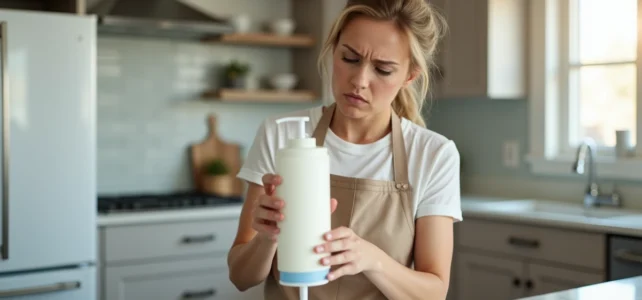
A whipped cream canister that dispenses a flat liquid or produces nothing at all is rarely a manufacturing defect. The problem almost always lies with the propellant gas, the temperature of the cream, or the condition of the valve mechanism. Understanding these three parameters allows for diagnosing the issue in a matter of seconds.
Internal pressure and propellant gas: the parameter that no one checks
The operation of a whipped cream canister relies on a balance between the pressure of the propellant gas and the viscosity of the cream. When this balance is disrupted, the output becomes irregular, liquid, or nonexistent.
In commercially available aerosol cans, the gas (usually nitrous oxide or a mixture of food propellants) is injected at a factory-calibrated pressure. Several manufacturers have adjusted their formulations in recent years to meet climate-related greenhouse gas targets. This change in internal pressure alters the resulting texture and makes the cream output less consistent, especially when the canister is nearly empty.
We observe a classic pattern: the canister works normally at first, then the cream becomes increasingly liquid as the pressure drops. It’s not the cream that has gone bad; it’s the gas that has escaped or been consumed faster than expected. To better understand why a whipped cream canister may stop working, one must first look at the fluid mechanics before questioning the product itself.
Another common cause of pressure loss is flat or upside-down storage. The canister should remain vertical, with the valve facing up during storage, and should only be turned valve down at the moment of serving. Storing it horizontally for several days is enough to disrupt the gas/cream distribution and cause pure gas to be expelled without cream.
Cream temperature and clogged nozzle: two distinct mechanical causes
Temperature is the most underestimated factor. A whipped cream canister taken out of the refrigerator for more than twenty minutes loses performance. The fat in the cream must remain cold for the gas to properly aerate it. At room temperature, the cream no longer retains the propellant gas and comes out in liquid form.
This phenomenon is amplified in summer or in a hot kitchen. We recommend placing the canister back in the refrigerator between uses, even for a few minutes.
Clogging of the valve and nozzle
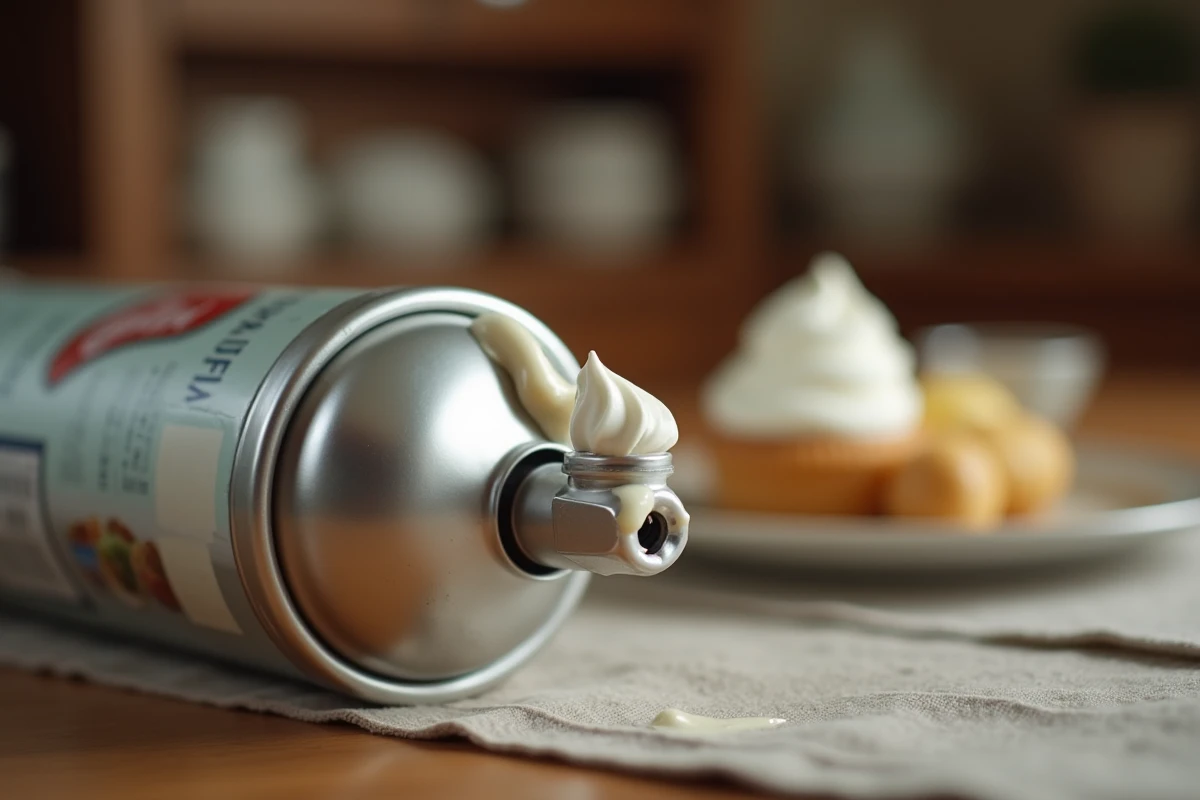
The output nozzle accumulates dried cream residues after each use. A simple deposit of solidified fat in the opening is enough to completely block the mechanism. The solution is to rinse the nozzle with warm water after each use.
On professional siphons, the problem is similar but also involves the internal O-ring. A worn or misaligned O-ring creates a permanent micro-leak that empties the nitrous oxide cartridge within a few hours, often without the user realizing it. The result: when it’s time to serve, the siphon is empty.
- Nozzle clogged with dried cream residues: rinse with warm water, use a fine needle to clear the opening if the blockage persists
- Cracked or deformed O-ring: replace systematically after a few months of intensive use, check the seating of the O-ring before each assembly
- Poorly pierced gas cartridge: on a siphon, re-tighten the cartridge holder until you hear the characteristic hissing sound of gas release, without forcing beyond that
Cream quality and fat content: the true foaming criterion
A commercial canister contains a calibrated formulation. However, for manually filled siphons, the fat content of the cream determines the result. A standard liquid cream with too low a fat content will not foam, regardless of the gas injected.
Whole whipping cream (at least 30% fat) is the functional minimum. Light creams or low-cost UHT creams sometimes display an insufficient fat content, and some manufacturers have altered their recipes in recent years. The result in a siphon is a soft foam that collapses within seconds.
UHT cream versus pasteurized fresh cream
UHT cream is more stable in storage, but its protein structure, altered by heat treatment, retains gas less effectively. Pasteurized fresh cream offers better foaming, provided it is kept between 2 and 4 °C until serving.
Another pitfall: adding sugar or flavoring directly into the siphon before charging. Any addition alters the viscosity of the cream and can prevent the gas from dissolving properly. Sugar should be added before filling, never after pressurizing.

Nitrous oxide cartridges: supply and variable quality
Regulations on nitrous oxide have tightened in France in recent years, mainly to combat misuse. This restriction has had a collateral effect on professionals and individuals: the supply of food-grade cartridges has become more complicated.
Some users resort to cartridges of dubious origin, sold online at low prices. These cartridges sometimes contain impure gas or insufficient quantities, which explains why a siphon that is otherwise in good condition no longer whips the cream properly.
- Check that the cartridges are labeled “food grade” and that they are compatible with the brand of siphon
- Store the cartridges in a dry place, at room temperature, away from any heat source
- Never reuse a pierced cartridge, even if it still seems to contain gas
A siphon that no longer works after changing cartridge suppliers almost always points to a gas quality issue, not a mechanical defect. Testing with a cartridge from a referenced brand (the siphon manufacturer usually recommends one) allows for confirming or ruling out this hypothesis in a matter of seconds.
The diagnosis of a faulty canister or siphon follows a logical order: gas, temperature, mechanics, cream. In the vast majority of cases, the problem can be resolved without replacing the equipment. A new O-ring, a reliable cartridge, and sufficiently fatty cream immediately put the device back in service.