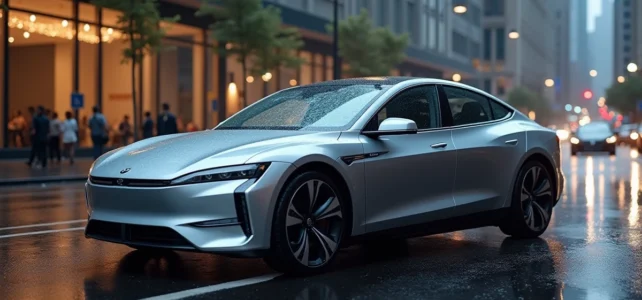
European customs duties on Chinese electric vehicles, strengthened at the end of 2024, have not slowed down the Asian offensive. They have simply redirected it. Chinese manufacturers are shifting their offerings towards plug-in hybrids (PHEV), a category that still escapes the surcharges and is restructuring the available ranges in the European market by 2026.
Chinese Plug-in Hybrids: The Tariff Bypass Redefining the Offer in Europe
The strategy is clear. Rather than absorbing the additional customs duties on pure electric vehicles, groups like BYD or Chery are redirecting their export catalogs towards dual thermal-electric PHEVs. These vehicles combine sufficient electric range for urban trips and a thermal engine that places them outside the scope of current surcharges.
Europe is already considering taxing these Asian powertrains more heavily. The Commission is examining the possibility of extending anti-dumping duties to plug-in hybrids, but the process takes time. In the meantime, Chinese PHEVs are gaining market share with prices that European manufacturers struggle to compete with in the compact SUV segment.
This shift has a direct consequence on the composition of the new car fleet: the share of PHEVs in registrations is growing faster than that of pure electric vehicles. Dealerships closely following automotive news are already adjusting their orders. To better understand these dynamics, we recommend exploring the auto section on Atlantic News, which regularly covers these regulatory and commercial developments.

Used Electric Vehicles: A Growth Segment That the Market Underestimates
The used electric vehicle market is changing in nature. The first mass-produced models (Renault ZOE, Volkswagen ID.3, Tesla Model 3) are reaching their third or fourth owner, with mileages that finally allow for an assessment of the actual degradation of batteries under normal usage conditions.
Refurbished Vehicles and Battery Warranty
The refurbished automotive sector is becoming structured. Specialized players offer residual capacity diagnostics (State of Health) before resale, with certification thresholds varying by platform. A certified used electric vehicle with a battery above 80% SoH sells significantly better than a model without diagnostics.
This trend addresses a concrete issue: the continuous rise in the price of new vehicles is pushing an increasing share of buyers towards used vehicles. The digitalization of sales (online auctions, video inspections, dematerialized maintenance histories) accelerates market fluidity. Brands that establish a certified used label for their electric vehicles gain a measurable advantage in customer loyalty.
After-Sales Service for Chinese Cars: The Real Purchase Criterion in 2026
The purchase price is no longer enough to convince. Field reports show that the availability of spare parts and the proximity of an authorized repairer weigh as heavily as the list price in the decision to purchase a Chinese vehicle.
Local Parts Stock and Repair Times
A vehicle immobilized for three weeks waiting for a body part or electronic module is costly, both in replacement rental and customer satisfaction. Chinese manufacturers investing in parts warehouses on European soil (Belgium, Netherlands, Germany) shorten these delays. Those relying solely on shipping from Asia are losing customers at the after-sales stage.
We observe that integrated distribution networks (own dealerships or exclusive partnerships with existing distribution groups) achieve better results than direct online sales models without physical presence. The French consumer, accustomed to the standards of Renault, Volkswagen, or BMW regarding after-sales service, does not tolerate degraded service, even for a substantial discount at purchase.
- Check for the existence of a stock of common parts (brakes, filters, body elements) on European territory before purchase
- Ensure that the network of authorized repairers covers the geographical area of daily vehicle use
- Request the average observed repair times, not just the theoretical times announced by the manufacturer
Eco-Score and European Standards: What Changes for Corporate Fleets
The regular update of the list of vehicles eligible for the environmental score is altering the decisions of fleet managers. Models like the Audi Q6 e-tron, Cupra Raval, or DS No. 7 have just been added to the list published in the Official Journal, granting tax benefits for companies that integrate them into their fleet.
The eco-score now conditions access to low-emission zones in several metropolitan areas. A vehicle that loses its eligibility during an update may find itself excluded from certain city centers, with direct consequences on professional use. Fleet managers must follow these updates with the same rigor as a maintenance schedule.
Decision-Making Between Pure Electric and Plug-in Hybrid in Fleets
The choice between a 100% electric vehicle and a PHEV depends on specific operational parameters:
- The average daily mileage per driver, which determines whether the electric range of a PHEV covers the trip without resorting to the thermal engine
- The availability of charging stations on-site or near intervention locations
- The applicable tax scale, which evolves each year and progressively penalizes hybrids whose thermal usage exceeds a certain threshold
- The projected residual value, more favorable to pure electric vehicles over a three to four-year horizon
Brands that offer simulation tools incorporating these variables (Ford, Volkswagen Commercial Vehicles, Renault) facilitate decision-making. A poor decision between electric/PHEV can cost several thousand euros per vehicle over the duration of the contract.
The automotive industry in 2026 is not just a technological race. The ability to structure a parts network, certify a reliable used market, and anticipate regulatory changes distinguishes manufacturers who gain market share from those who are content to showcase prototypes at trade shows.